The process converts carbon dioxide, nitrogen and phosphorous\r\ninto protein, and releases oxygenThe search for sustainable fish feed has led innovators to\r\ningredients like soy, peas,&nb...
The process converts carbon dioxide, nitrogen and phosphorous\r\ninto protein, and releases oxygen
The search for sustainable fish feed has led innovators to\r\ningredients like soy, peas, wood, rapeseed, insects and\r\neven microbes\r\nfed natural gas. Now Marissa Cuevas is trying a different feed input: fish\r\noutput.
Cuevas is the founder and CEO of MicroTERRA, a Mexico-based\r\nstartup developing systems that use microalgae to turn fishpond wastewater into\r\nprotein for fish feed. The circular system not only cleans and oxygenates dirty\r\npond water for re-use, but could allow a fish farmer to produce up to 60\r\npercent of their own feed, she says.
“It’s autonomous production on-site,” Cuevas told the Advocate.\r\n“The idea is to provide technology so they can be self-sufficient in their fish\r\nfeed production.”
Cuevas, who has a background as a renewable energy engineer\r\nand a master’s degree in sustainability management came up with the upcycling\r\nidea after learning about the impacts of wastewater and agricultural runoff,\r\nwhich can deposit high levels of nitrogen and phosphorus in oceans and\r\nwaterways, leading to toxic algae blooms, fish die-offs and low-oxygen areas\r\nknown as dead zones.
“I thought, there must be a way to take those nutrients out\r\nof the water and put them back in the soil, because ultimately nitrogen and\r\nphosphorous are key to our nutrition,” she said.

Left to right: Paola Constantino, CTO; Arlet Rodriguez,\r\nbiotech researcher; Mariana Elías, project manager; Marissa Cuevas, CEO;\r\nFernando Cuevas, trainee. Photo courtesy of MicroTERRA.
From microalgae to\r\nfish feed
Cuevas ruled out using kelp or seaweed to capture wastewater\r\nnutrients, because of the plants’ long growing time. “Then I looked at the\r\nsmallest plants in the world – microalgae,” she said.
She developed a system in 2018 for turning wastewater into\r\nfertilizer but found there was not enough of a market for the product. Then\r\nwhile interviewing a farmer for her market research, she noticed tilapia tanks\r\non his property.
“As soon as I saw the tilapia tanks, I thought, this is the\r\nwater we need,” she said. “It was full of nutrients and it was already in the\r\npipeline.”
When Cuevas learned that one of the farmer’s biggest\r\nproblems were the cost and variability of his fish feed, the lightbulb went off.
“I went back to our CTO and said, ‘Can we do fish feed?’”\r\nCuevas recalled. “She said, ‘of course we can.’”
For Cuevas, the idea “made so much sense,” she said. “By\r\ncreating a sustainable product out of that wastewater, we’re also replacing\r\nfishmeal. The impact on oceans would be even bigger.”
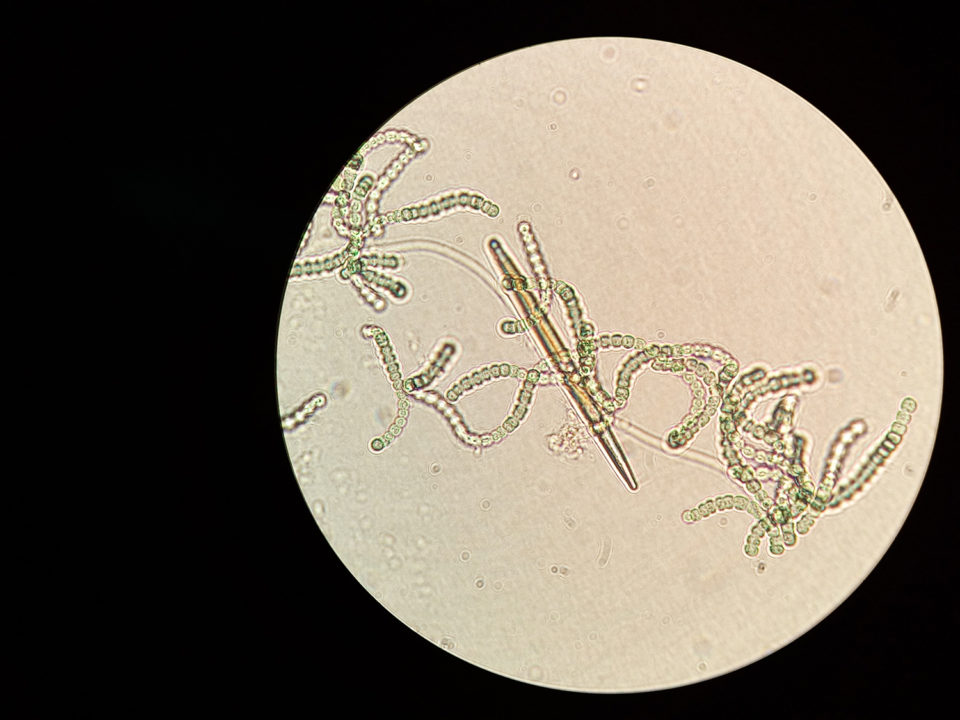
A microscopic view of the microalgae consortia MicroTERRA\r\nuses to clean water. “These are the heroes of the story, the fastest biomass on\r\nearth, and therefore the best microorganism to clean water,” said CEO Marissa\r\nCuevas. Photo courtesy of MicroTERRA.
A self-contained\r\nsystem
In 2019, the company launched its pilot project, a The 5,000-liter system now operating at a fish farm in Irapuato, Mexico, which\r\nproduces around 4 kg of fish feed per day.
In the MicroTERRA system, wastewater flows into bioreactors,\r\nwhere it mixes with microalgae. The tiny organisms absorb carbon dioxide from\r\nthe water, along with nitrogen and phosphorous, converting the nutrients into\r\nprotein, and releasing oxygen. The cleaned water is returned to the fish pond,\r\nwhile the protein is mixed with other ingredients to create pellets for fish\r\nfeed.
Technicians can monitor the system remotely with sensors and\r\ncommunicate with the farmer if something needs attention, like adjusting the\r\npH, or opening a valve to circulate water.
Cuevas estimates a 100,000-liter system would cost about\r\n$250,000.
“The idea is that because it’s displacing fish feed, the payback period is approximately five to seven years,” she said.
MicroTERRA is focusing on Latin America as a market for the\r\nsystems, because of the region’s warm climate and abundance of sunlight. With\r\nno need for artificial lighting or temperature, “our systems can stay\r\naffordable,” said Cuevas.
In addition to selling systems to fish farmers, Cuevas is\r\nlooking at fish feed producers as a potential market. “Latin American has a\r\nhuge market not just for fish but also for fish feed,” she said. “They’re\r\nalready searching for sustainable protein, and I think for them our system\r\ncould be super interesting.”
The company’s next project, a 25,000-liter system, which\r\nwill produce an estimated 20 kg of fish feed per day, is scheduled to be\r\ndeployed in February and March at a tilapia farm in Apaseo el Grande, Mexico.
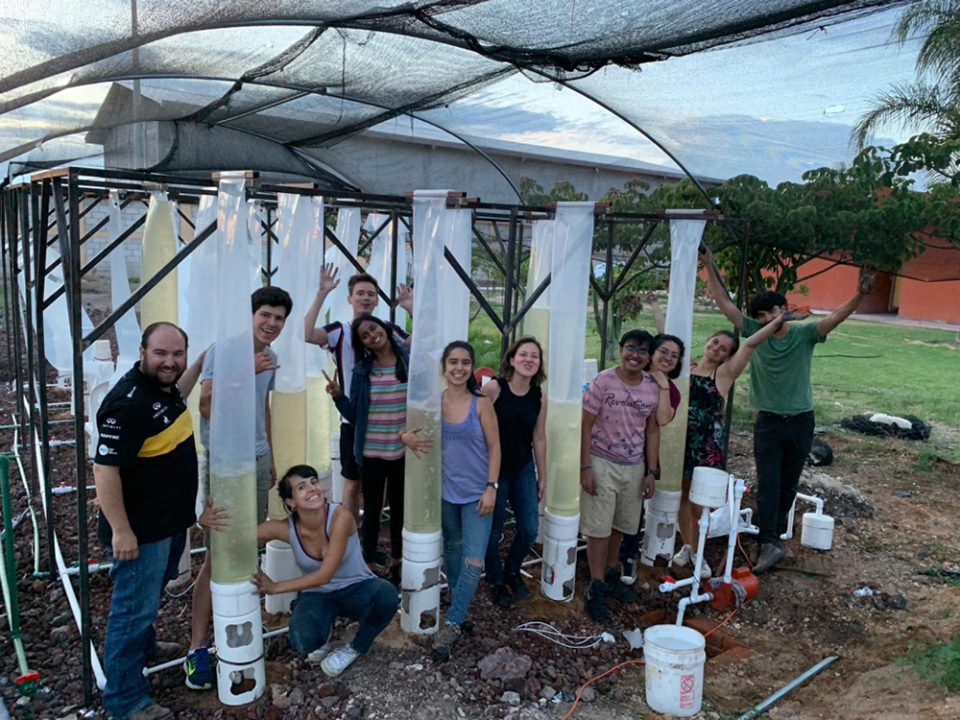
The MicroTERRA team. Courtesy photo.
‘Really intriguing\r\nidea’
The company was selected for the 2019 cohort by the\r\nTechstars Sustainability Accelerator, a prestigious three-month mentoring and\r\nbusiness development program backed by The Nature Conservancy. The program\r\nseeks to support viable businesses that are addressing top environmental\r\nchallenges, including protecting land and water, providing food and water\r\nsustainably, building healthy cities, and tackling climate change, according to\r\nRobert Jones, global lead for aquaculture at TNC. The accelerator had been\r\nactively seeking aquaculture companies to apply; MicroTERRA was the first to be\r\naccepted.
“I think MicroTERRA has a really intriguing idea,” Jones\r\nsaid. The company stands out because it addresses two major challenges facing\r\naquaculture: reducing the environmental impact of effluent, particularly from\r\npond-based systems; and feed sustainability. The concept addresses both\r\nchallenges in a self-contained system, while also building on the concept of a\r\ncircular economy and regenerative agriculture, he argued.
“We do need innovations like this to help aquaculture become\r\nmore sustainable,” Jones said. Particularly intriguing is the fact that\r\nMicroTERRA’s system would be beneficial to small and medium-sized pond-based\r\naquaculture operations. “I think that’s very compelling.”
Scaling up
Jones worked with MicroTERRA to address technical challenges\r\naround commercialization, including building connections with technical experts\r\nto help design studies on feed profiles.
Cuevas said the program helped MicroTERRA transition from\r\nR&D to the next phase, and scale-up. “Techstars was an amazing experience\r\nto grow the business behind the idea,” she said.
The startup’s next step is a fundraising round, planned for\r\nthe first quarter of 2020. Cuevas also hopes to form a strategic partnership\r\nwith a fish feed producer. “Ideally we would focus only on the wastewater\r\ntreatment and transforming it into a sustainable protein and let the experts in\r\nthe field create the fish feed,” she said.
MicroTERRA has a bright future, Jones said.
\r\n\r\n\r\n\r\n\r\n\r\n\r\n\r\n\r\n\r\n\r\n\r\n\r\n\r\n\r\n\r\n\r\n\r\n\r\n\r\n\r\n\r\n\r\n\r\n\r\n\r\n\r\n\r\n\r\n\r\n\r\n\r\n\r\n\r\n\r\n\r\n\r\n\r\n\r\n\r\n\r\n\r\n\r\n\r\n\r\n\r\n\r\n\r\n\r\n\r\n\r\n\r\n\r\n\r\n\r\n\r\n\r\n\r\n\r\n\r\n\r\n\r\n\r\n\r\n\r\n\r\n\r\n\r\n\r\n\r\n
“The leadership of the company is very strong. This is a high-energy, enthusiastic, very knowledgeable group of female entrepreneurs\r\nfrom Mexico, who really want to see this done for the good of the planet and\r\nthink they can make money at it,” he said. “I wouldn’t underestimate the\r\nability of this group to be successful.”
Source: Aquaculture Alliance

Ditulis oleh
Tim Minapoli
Kontributor
Pakar di bidang akuakultur dengan pengalaman lebih dari 15 tahun. Aktif berkontribusi dalam pengembangan industri perikanan Indonesia.